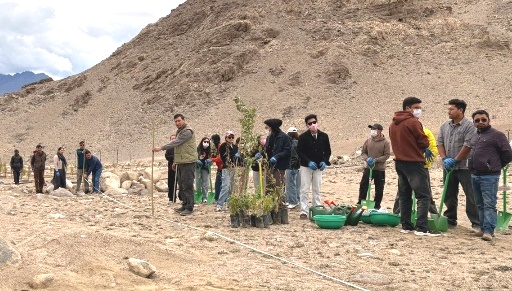
Leh: In a significant step towards strengthening afforestation efforts in Ladakh and enhancing the ecological resilience of the fragile Trans-Himalayan cold desert ecosystem, the Leh Forest Division successfully conducted a comprehensive Theory-Cum-Field Training Programme on Advanced Forestry Plantation Techniques for its frontline field staff.
The training programme was conducted by Amarjeet Kujur, IFS, Divisional Forest Officer (DCF), Leh, and chaired by Rajesh S., IFS, Additional Principal Chief Conservator of Forests (PCCF) and Chief Wildlife Warden, UT Ladakh.
Addressing the inaugural session, Rajesh S. emphasised the importance of mastering cold-desert plantation techniques to achieve sustainable outcomes in ecological restoration, community forestry, agroforestry, urban forestry and food forest development across Ladakh. He highlighted the need for scientific and skill-based approaches to improve the success of afforestation programmes in the region’s challenging climatic conditions.
The training focused on specialised high-altitude forestry plantation techniques designed to overcome the harsh environmental constraints of Ladakh’s cold desert landscape. Combining intensive classroom sessions with practical field demonstrations, the programme equipped forest guards, block officers and frontline personnel with data-driven methodologies aimed at improving sapling survival rates, conserving scarce water resources and ensuring long-term plantation success.
The programme was structured around key technical modules addressing the unique challenges of forestry in Ladakh:
Climate-Resilient Species Selection
Participants were trained in selecting ecologically suitable and climate-resilient species for afforestation. The module focused on native and adaptable species such as Willow (Salix), Poplar, Apple, Apricot and Shukpa (Juniperus polycarpos), balancing ecological restoration objectives with community needs.
Advanced Plantation Techniques
The training introduced innovative plantation methods, including the construction of micro-catchments and specialised trenches designed to trap drifting snow, reduce wind impact and maximise moisture retention in low-precipitation environments.
Soil Structure and Nutrient Improvement
Recognising the challenges posed by Ladakh’s sandy and nutrient-deficient soils, technical experts demonstrated organic soil conditioning techniques, including the use of compost, structural binders and moisture-retaining natural additives to create a healthy rhizosphere and improve plant growth.
Arid-Zone Irrigation Management
To address extreme water scarcity, participants learned efficient irrigation practices such as deep-root watering, subsurface moisture conservation and low-evaporation water management techniques, specifically tailored for high-altitude cold desert conditions.
Moving beyond classroom instruction, participants engaged in hands-on field exercises involving plantation bed preparation, soil treatment, sapling handling and precision planting techniques. These practical sessions enabled staff to directly apply the scientific concepts learned during the programme.
Speaking during the concluding session, DCF Amarjeet Kujur stressed that successful greening of high-altitude cold deserts requires moving beyond conventional forestry practices.
“Every sapling planted in Ladakh faces severe climatic stress. By focusing on moisture conservation, soil improvement and scientific plantation methods, we are shifting our emphasis from merely increasing plantation numbers to ensuring long-term survival and sustainability,” he said.
The Leh Forest Division plans to implement these standardised plantation techniques across upcoming afforestation initiatives, including the Indus River Green Corridor Initiative, Ladakh Trans-Himalayan Cold Desert Urban Forestry and Food Forest Initiative, and various Community Woodlot Programmes under the Department of Forest, Ecology and Environment, UT Ladakh.
The division also expressed gratitude to Thiksey Gonpa for its support in organising the training programme and for actively participating in local greening and environmental conservation initiatives.