Pact opens access to major academic platforms and ONOS resources for students, researchers and faculty at Sindhu Central University, Khaltse.
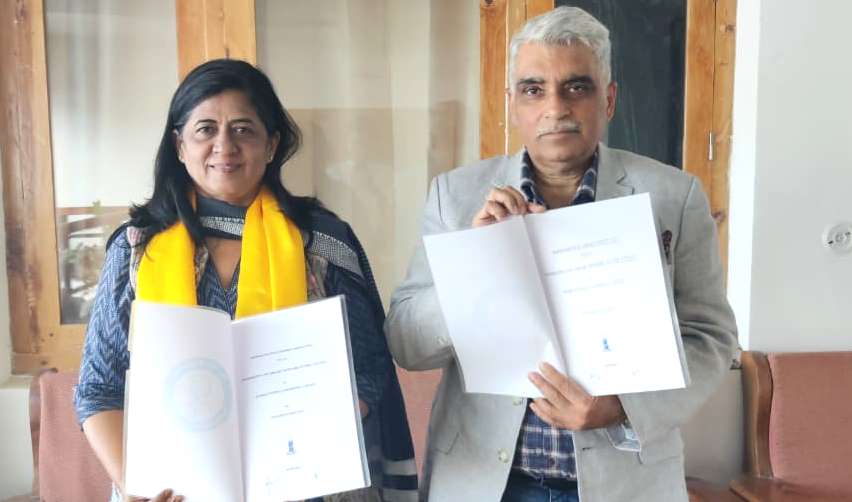
LEH: Strengthening digital learning, research and library services in Ladakh, Sindhu Central University (SCU), Khaltse, Leh, has signed a Memorandum of Understanding (MoU) with the Information and Library Network (INFLIBNET) Centre, Gandhinagar, Gujarat.
The agreement was signed under the leadership of SCU Vice Chancellor Prof. Rajeev Rattan Sharma and INFLIBNET Director Prof. Devika Madaill, marking an important milestone in the university’s efforts to expand access to high-quality digital academic resources.
Under the MoU, SCU will gain access to a range of major INFLIBNET digital platforms and research services, including IndCat, SOUL, INFED, ShodhGanga, ShodhShuddhi, ShodhChakra, ILM, IRINS, ShodhPrabha and INFYMEET, among other resources. These platforms are expected to significantly enhance access to scholarly literature, research databases, institutional repositories, plagiarism-detection services, academic networking and library-management tools.
A major benefit of the collaboration will be access to resources available through the One Nation One Subscription (ONOS) initiative, enabling students, research scholars and faculty members of SCU to access a wider range of scholarly resources through their digital devices.
The MoU is particularly significant for a young central university operating in a geographically remote region, as it will help bridge gaps in access to academic and research resources. With digital resources becoming increasingly important to higher education, the collaboration is expected to support students and scholars in undertaking advanced research without being constrained by the region’s geographical limitations.
Both institutions described the agreement as an important landmark for SCU, with faculty members, research scholars and students set to be the primary beneficiaries. The integration of INFLIBNET services is expected to strengthen the university’s academic ecosystem and provide its stakeholders with greater opportunities for research, knowledge-sharing and scholarly engagement.