LEH: The State Election Commission (SEC) has notified 36 constituencies reserved for women across the eight Ladakh Autonomous Hill Development Councils (LAHDCs), marking a significant step towards strengthening women’s political representation and participation in grassroots democratic governance in the Union Territory.
The reservation, announced through a council-wise list issued by State Election Commissioner Sudhanshu Pandey, covers the Hill Councils of Leh, Sham, Nubra, Changthang, Kargil, Drass, Zanskar and Sankoo.
The distribution provides for 36 women-reserved constituencies out of the total territorial constituencies across the eight councils, ensuring representation for women in the elected local governance framework.
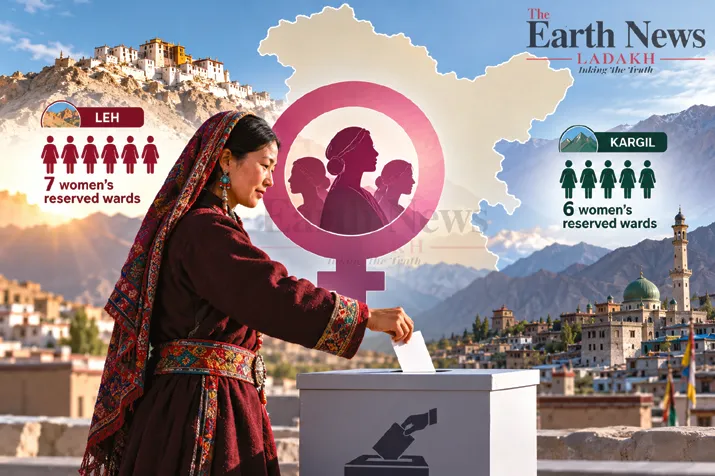
Among the councils, Leh has the highest number of women-reserved constituencies at eight, followed by Kargil with seven and Sankoo with five. Changthang has four, while Sham, Nubra, Drass and Zanskar have three constituencies each.
The council-wise allocation includes Chuchot Gongma, Stok, Igoo, Saboo, Spituk, Shey, Gompa-Sankar and Skara in Leh; Lamayuru-Bodhkharboo, Khalsi and Saspol in Sham; and Chamschen Charasa-Tegar, Sumoor and Disket in Nubra.
In Changthang, Nyoma, Rong, Durbuk and Tangtse have been reserved for women.
In Kargil, the reserved constituencies are Hardass, Chuliskambo, Lotchum, Yourbaltak, Goma Kargil, Poyen and Baroo. Drass has Matayeen, Rambirpur and Shimsha Kharboo, while Raru, Cha and Phay have been reserved in Zanskar.
In the newly constituted Sankoo Hill Council, the five women-reserved constituencies are Thasgam Thuvina, Sangrah, Panikhar Taisuru, Saliskote and GM Pore Tambis.
The notification assumes significance in the context of the restructuring and expansion of the Hill Council framework in Ladakh, particularly following the creation of additional councils and the reorganisation of territorial constituencies.
With 36 constituencies earmarked for women, the reservation is expected to provide greater opportunities for women to enter electoral politics, assume leadership roles and participate directly in decisions concerning local development, public services and community welfare.
The move also adds an important dimension to the forthcoming electoral exercise for the Hill Councils, as political parties and prospective candidates will have to factor in the notified reservation pattern while preparing their electoral strategies.