Dr. Vikash Ranjan Singh and Dr. Tsultim Zangmo
On 30th June 2026, Pakistan hosted the first-ever international Indus Waters Summit in Islamabad, where Victor Gao, a prominent Chinese political commentator, scholar, and Vice President of Beijing-based think tank, made a fairly controversial statement regarding India’s actions towards Pakistan in the aftermath of terror attacks in Pahalgam. He declared, “If India stops Pakistan’s water, China will stop India’s water.” This statement highlights the complex and sensitive nature of transboundary water connectivity, as well as the relations and commerce based on water trade, especially when a significant portion of China’s commerce itself is based in the Indo-Pacific region.
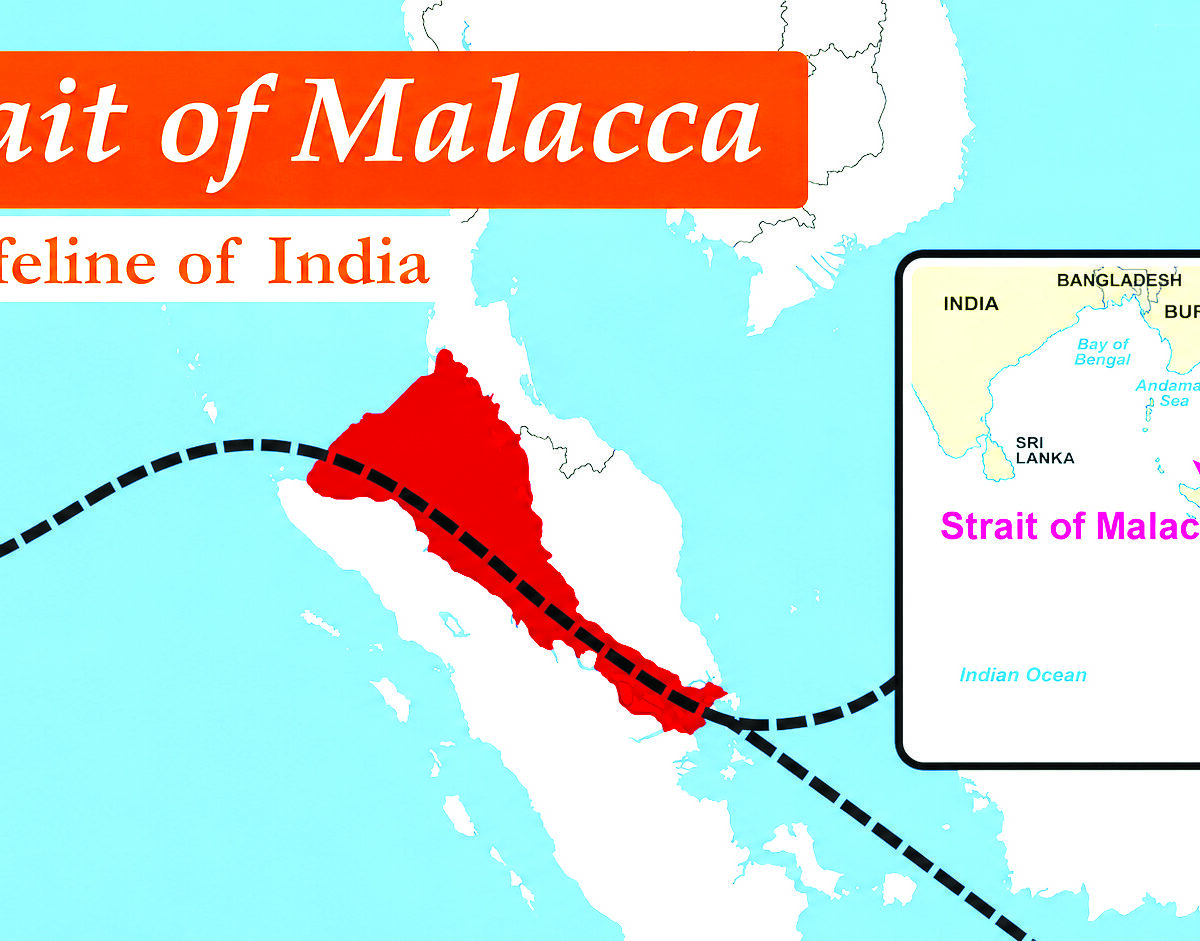
The Indo-Pacific region is considered one of the world’s most important geopolitical and economic regions, with the Strait of Malacca serving as its core. Located between the Malay Peninsula and the Indonesian island of Sumatra, and connecting the Indian Ocean to the South China Sea, it stretches approximately 900 kilometres in length and 65-250 kilometres in width. Although, geographically, it is rather narrow, its geopolitical significance is enormous. Nearly one-third of global maritime trade and a substantial proportion of East Asia’s energy imports pass through this maritime corridor, making it one of the critical strategic chokepoints of global trade, which can easily be disrupted, affecting almost the 80-85% of China’s and other countries’ trades.
According to reports, nearly 94,000 vessels pass through the Strait annually. Approximately 25 percent of globally traded goods pass through this narrow sea lane, while over 35 percent of seaborne crude oil and nearly 20 percent of global liquefied natural gas shipments continue to depend on this corridor. For the major economies such as China, Japan, South Korea, and India, uninterrupted navigation through the Strait of Malacca is essential for economic stability, energy security, and industrial production.It is, therefore, easilyunderstood that the Strait of Malacca occupies a central place in contemporary geopolitics. Any disruption to maritime traffic through this narrow passage would immediately affect global supply chains, insurance costs of shipping, energy prices, and international trade. The increasing strategic competition in the Indo-Pacific has transformed the Strait from merely a commercial waterway into one of the world’s most contested geopolitical spaces.
India’s recent diplomatic engagements demonstrate that New Delhi fully recognizes this strategic reality. The visit of Japanese Prime Minister to India from 1-3 July 2026 for the 16th India-Japan Annual Summit with the Indian Prime MinisterNarendra Modi, followed immediately by Prime Minister Modi’s visit to Indonesia from 6-8 July 2026, reflected India’s sustained efforts to deepen strategic partnerships across this region. Though these meetings covered issues ranging from advanced technology and resilient supply chains to economic cooperation and defense collaboration, maritime security remained at the centre of discussions.India’s growing maritime cooperation with Japan and Indonesia represents far more than bilateral diplomacy. It reflects New Delhi’s long-term vision of ensuring that the Indo-Pacific remains free, open, inclusive, and governed by international law. Unlike traditional military alliances designed to dominate strategic regions, India’s partnerships seek to preserve the security of international sea lanes, upon which depends the prosperity of the entire region.A key component of India’s maritime cooperation with Indonesia is the development of Sabang Port, situated at the northern tip of Indonesia’s Sumatra Island, only a few hundred kilometres from the western entrance of the Strait of Malacca.Because of its geographical position, Sabang occupies one of the most strategically valuable locations in Southeast Asia. Rather than representing an effort to dominate the Strait, the Sabang initiative reflects a cooperative model of maritime security where regional powers work collectively to secure shared sea lanes. Along with these two important actors of maritime trade, Prime Minister Modi also visited Seychelles, resulting in enhanced maritime support from India to Seychelles, making India’s strong presence felt across the region. During PM Modi’s visit to Auckland from July 10 to July 11, 2026, both nations, India and New Zealand, decided to share their interests in establishing significant naval, strategic, and logistical agreements. Both have signed a logistics pact allowing Defence Forces of both nations to share port facilities, supplies, and technical support and established regular, structured naval cooperation. They also finalized an implementation arrangement for sharing underwater mapping data, technical capacity building, and maritime navigation safety practices. All these nations together, Japan, New Zealand, Indonesia and Seychelles, define India as an important actor in Indo-Pacific region, giving India an important strategic position from where it can easily influence the maritime trade across the world.
In the same vein, India has decided to transform the Andaman and Nicobar Islands into one of the most significant strategic assets in the Indo-Pacific. Located nearly150 kilometres from the western entrance of the Strait of Malacca, these islands provide India with a geographical advantage, which is unmatched by most regional powers. Their location enables continuous maritime domain awareness over one of the busiest commercial shipping routes in the world, while at the same time strengthening India’s naval reach across the eastern Indian Ocean.The Government of India’s ambitious ₹80,000 crore Great Nicobar infrastructure project seeks to convert the island into a modern maritime, commercial, and strategic hub. The proposed international trans-shipment terminal, expanded airfield, improved road connectivity, logistics facilities, and dual-use infrastructure are expected to transform Great Nicobar into an important node connecting the Indian Ocean with Southeast Asia. By enhancing India’s maritime surveillance capabilities and reducing dependence on foreign trans-shipment ports such as Singapore and Colombo, this initiative intends to strengthen India’s long-term maritime resilience while contributing to regional connectivity. For strategic planners across the world, Andaman and Nicobar Islands represent one of India’s greatest geopolitical advantages. Positioned like a natural observation post overlooking the western gateway of the Strait of Malacca, these islands allow India to monitor commercial shipping, enhance anti-piracy operations, coordinate humanitarian missions, and respond rapidly to regional contingencies. In an era where maritime security increasingly determines economic security, this geographical advantage significantly enhances India’s role as a security provider in the Indian Ocean region.
Nevertheless, India’s growing maritime capabilities raise an important question. If geography has placed India in such a strategically advantageous position, why has India never sought to transform the Strait of Malacca into an instrument of geopolitical power projection?
The question becomes particularly relevant in light of recent international developments, and its answer lies partly in India’s strategic culture and partly in its civilizational worldview.
The recent conflicts surrounding the Strait of Hormuz demonstrated how profoundly a single maritime chokepoint can affect global politics. As tensions in West Asia escalated and concerns emerged regarding possible disruptions to shipping through Hormuz, international energy markets reacted almost immediately. Oil prices experienced volatility, insurance premiums for commercial shipping increased, and governments across Asia and Europe began assessing the potential impacts on their energy security. This incident served as a reminder that control or even the perceived possibility of disruption over a narrow maritime passage can generate economic consequences extending far beyond the immediate region.
Strait of Malacca is even more strategically important. As regards China, this strait can be referred to as the primary connection between the industrial facilities of the country and the energy sources of the Middle East and Africa. Over 80 percent of China’s oil imports pass through Strait of Malacca. The same applies to Japan and South Korea. It means that any possible prolonged blockage of Strait of Malacca would have much wider consequences than just those located in Southeast Asia and would affect manufacturing, foreign trade, and energy markets all around the world. There is also another country that is quite unique concerning this strategic location. India does not control Strait of Malacca, but due to its geographical location it has the possibility to observe any events there and, in case of military emergency, disrupt maritime traffic in the busiest shipping lane in the world. That is why Andaman and Nicobar Command is one of the most strategically important assets of India in the Indo-Pacific region.
However, India’s conduct has consistently differed from approaches that seek to weaponise geography for political or economic coercion. Despite possessing significant strategic leverage, New Delhi has never supported restricting commercial navigation through the Strait of Malacca, nor has it attempted to use this vital maritime corridor as an instrument of diplomatic pressure against other nations. Instead, India’s maritime strategy has remained centred upon ensuring secure sea lanes, combating piracy, supporting humanitarian assistance and disaster relief, and promoting freedom of navigation in accordance with international law.
Far from being a coincidence and even less so a product of the current-day diplomacy, this behaviour emerged as a result of centuries of history, during which time India became one of the oldest maritime civilizations in the world. Far before the very notion of the nation-state became known to mankind, Indian traders, sailors, monks and scholars set forth across Southeast Asia via the Bay of Bengal, thus turning the Indian Ocean into the massive network of business and interaction. Indian states were blessed with exceptional navies but did not tend to look at the sea as something where the element of coercion or monopoly could be practiced. The maritime influence of these states came primarily through business, diplomacy, religion, education and culture, rather than through conquest and control of territories through war. This historical background is important to understand the India’s present maritime approach. To understand why India today views the Strait of Malacca as a shared global responsibility rather than a geopolitical weapon, one must first revisit the remarkable maritime history of the Indian kingdoms that sailed these waters centuries before the modern Indo-Pacific was ever imagined.
The geopolitical significance of the Strait of Malacca in the modern world is well discussed in many scholarly writings. Yet, the geopolitical importance of this strait is not limited to the political rivalry of nation-states. Before the emergence of the colonial powers and the geostrategic region known today as Indo-Pacific, the Strait of Malacca was one of the busiest waterways linking the Indian Ocean with the South China Sea. Indian peoples sailed these waterways long before the emergence of European powers in the region. The Strait of Malacca was, therefore, a place for interaction between civilizations. Unlike most maritime nations that normally aimed at controlling important waterways and straits, India used the seas as a means of conducting business, diplomacy, and interaction with civilizations. Through economic achievements, commercial activities, religious exchanges, and cooperation with locals, Indian states managed to establish their influence in Southeast Asia. Hence, the idea of connectivity, and not colonialism, guided India’s maritime conduct, a principle that India continues to follow in the modern world.
One of the first Indian dynasties which developed maritime connections was the Pallava dynasty, which ruled Southern India from its capital Kanchipuram between the sixth and ninth centuries CE. The Pallavas realized that wealth generation was possible not only by controlling the land, but also by controlling the sea trade. One of the most famous ports in the Pallava period was the town of Mamallapuram (now Mahabalipuram) constructed during the rule of Narasimhavarman I, and it became one of the most active trade centers in the Bay of Bengal. Mamallapuram served as the launch base for merchant ships sailing across the Bay of Bengal into present day Myanmar, Thailand, Malaysia, Indonesia and beyond. This seafaring heavily relied on the regularity of monsoons coming from the southeast direction which carried ships to Southeast Asia and then brought them back to India. During their journey, the islands of Andaman and Nicobar served as an important base for the acquisition of fresh water before entering the Straits of Malacca. To date, these islands serve as important strategic assets, indicating the significance of geography in India’s maritime endeavors through almost fifteen hundred years.
It should be noted that the Pallavas did not assert their presence through domination by military forces but through the presence of merchants’ guilds, diplomacy, and trade with the local chiefs. Indian textile and iron products, beads, ivory, and precious stones were exchanged for spices, camphor, aromatic woods, gold, and forest products from Southeast Asia. The culture of Sanskrit literature, temples architecture, arts, laws, and religious philosophy accompanied those goods. Peaceful trade is the way Hinduism and Buddhism spread in Southeast Asia, and not through conquest or predatory evangelism. For example, the Cambodian temple architecture, Indonesian inscriptions, and Sanskritic traditions in the Malay archipelago provide evidence of the Pallava influence in Southeast Asia.
The notion of maritime conduct being guided by connectivity and not colonialism saw its greatest naval manifestation through the reign of Rajaraja Chola I and his son, Rajendra Chola I, of the Chola Empire, in the tenth and eleventh centuries CE. The Cholas were one of the most advanced maritime civilizations of medieval Asia. They ruled over the enormous Bay of Bengal area and had regular contacts on maritime routes from Sri Lanka to Southeast Asia and southern China. It is the naval campaign against the Srivijaya Empire, in 1025 CE, for which the Cholas are mostly remembered. Although this operation certainly demonstrates the exceptional skills of the Chola navy, it should be considered in its historical perspective. The majority of contemporary historians tend to see it as an expedition to protect economic and maritime interests in the region, rather than a colonization of Southeast Asia. What is more important, the Cholas neither occupied Srivijayan territories, nor established any colonial administration there or made attempts to gain political control over the Strait of Malacca. Trading and diplomatic relationships continued during subsequent generations.
This distinction between maritime connectivity and maritime colonialism is important. Powerful naval capabilities, like those of the Cholas, existed, and yet they were not converted into instruments of permanent maritime hegemony. Instead of monopolizing the Strait of Malacca, the Cholas ensured that commercial routes remained functional, enabling merchants from India, Southeast Asia, and China to continue benefiting from uninterrupted trade.
Additionally, the maritime culture of eastern India has been another major factor influencing the trade via the Strait of Malacca. The ancient kingdom of Kalinga, covering almost the whole of modern-day Orissa, maintained flourishing commercial connections with Southeast Asia right from ancient times. The sailors of Kalinga were adept seamen, who used to sail to the Strait of Malacca to reach the flourishing ports of Sumatra, Java, Bali, and southern China. The traditional practice of “Boita Bandhana” in Orissa, still followed during the festival of Kartik Purnima, stands out as living evidence of the hoary overseas trade. The launching of small boats in the rivers harks back to the launching of trading ships from eastern India to Southeast Asia. Such traditions highlight the fact that the maritime culture of India was always associated with trade rather than war.
There are enough historical references which indicate that the merchants from India had earned themselves quite an impressionable reputation in Southeast Asia because of their dependability and ethical approach towards conducting business. It is quite apparent from the use of the term “Keling” for Indians in the Malay regions, even though the word carried a different meaning during various periods of history. The existence of Indian merchants in Southeast Asia was a result of cooperation and integration, and not military settlement. The best example of maritime diplomacy involving both religion and intelligence could be seen in the history of the Pala Empire of eastern India. For more than five centuries, starting from the eighth, there had been cordial relations maintained by the rulers of the Pala and the Srivijaya Empires, who were influential in the Strait of Malacca region.
One of the strongest evidences that support this theory is the Nalanda Copper Plate Inscription from the ninth century during the reign of Devapala. According to this inscription, Balaputradeva, the ruler of Suvarnadvipa (believed to be Srivijaya) had requested for permission from King Devapala to construct a Buddhist monastery in the celebrated Nalanda Mahavihara. Not only did the king sanction his request but also allotted him five villages in order to manage the expenditure of the monastery along with the well-being of its students. Such a spectacular instance from history reveals that connections of education and religion were utilized by both powers in order to foster friendly relations and mutual respect. During the period when Srivijaya ruled over one of the most important maritime crossroads of the world, the connection between India and Srivijaya was based on intellectual interaction and not rivalry. Monks who travelled from India to Srivijaya and then further to China would pass through Strait of Malacca. Pilgrims carried manuscripts, and translations of scriptures and philosophical doctrines along with them, which led to the establishment of cultural connections throughout the continent.
Like the other Indian maritime powers, the Pandyans and Cheras also played a significant role in the economic life of the Indian Ocean through their ports located on the western and southern coast of India that exported goods such as pepper, pearls, spices, ivory, textiles, precious stones, and superior quality steel to Southeast Asia. Rather than territorial expansion, both the empires opted for economic exchange. Tamil merchant guilds played an essential role in trade across the Malacca Strait because they were highly successful owing to their diplomatic negotiations and alliance with the Southeast Asian kingdoms. Rather than attempting to politically control the waters, the guilds ensured through these negotiations that they had the right to trade, which would benefit both the Indian and the local kingdoms.
Collectively, the experiences of the Pallavas, Cholas, Kalingas, Palas, Cheras, and Pandyans reveal an important historical pattern. These kingdoms possessed maritime capabilities, maintained powerful commercial fleets, and exercised considerable influence across the Indian Ocean. Yet their influence was sustained primarily through trade, diplomacy, religion, merchant guilds, and cultural exchange rather than through military occupation of strategic chokepoints. Indian kingdoms generally sought secure and prosperous maritime networks that facilitated commerce for multiple participants. Their objective was not to close the seas but to keep them open.
Modern India continues to observe a similar maritime outlook. India always seeks to advance free, open, inclusive, and rules-based Indo-Pacific, emphasizing freedom of navigation, adherence to international law, and peaceful dispute resolution. Modern maritime activities of India are, therefor, centered around anti-piracy measures, humanitarian assistance and disaster relief, search and rescue, and evacuation operations.
The approach finds its roots in one of the oldest civilizational maxims of India known as “Vasudhaiva Kutumbakam”, meaning “the world is one family.” The maxim informs India’s contemporary foreign policy doctrines too. It revolves around the idea that in light of the interdependence of the world, there must be cooperation and not coercion among countries, so that they prosper together. In terms of the maritime doctrine, Vasudhaiva Kutumbakam translates into seeing the oceans as global commons and not as instruments of geopolitical leverage or coercion. Oceans and seas, strategic passages like the Strait of Malacca, do not belong to any country. Instead, they play an important role in the economic prosperity of many countries and peoples. Thus, according to Indian maritime doctrine, sea routes should be secured for mutual benefit and not for creating geographical economic dependencies.
Furthermore, strategic cooperation with Japan, Indonesia, Australia, France, the USA, and even with other ASEAN countries adds more value to this strategy. Construction of the Sabang port, development of facilities in Andaman & Nicobar Islands, Malabar Exercise and collaboration in forums such as Quad indicate that the Indian intention is not domination of the region, but maritime stability. In view of increasing competition in Indo-Pacific region, the Malacca Straits is sure to assume great importance in international strategy. Given the Chinese effort to have alternative route through sea, coupled with rising naval power in Asia and rivalry among major powers, this strait is sure to retain its strategic importance in the world.
India today is one of the best positioned states in the eastern Indian Ocean region. Ownership of the Andaman and Nicobar islands, the development of its maritime infrastructure, the expansion of its naval strength, and the establishment of partnerships with like-minded nations, not only demonstrate Indian capacity but also credibility to shape the future of the Indo-Pacific region. In a world increasingly shaped by geopolitical rivalry, India’s maritime vision offers an alternative model, one in which strength is measured not by the ability to close the seas, but by the commitment to keep them open.
(Dr. Vikash Ranjan Singh is a faculty member at Zakir Husain Delhi College (Evening), University of Delhi, and Dr. Tsultim Zangmo is a faculty member at the Centre for Chinese Studies and Language, University of Ladakh.)