JTN says people deprived of elected representatives; BJP defends winter Hill Council polls, questions Congress’s dual stand and urges voters to reject boycott
LEH: Mounting a strong political defence of the forthcoming Panchayat, Municipal Council and Ladakh Autonomous Hill Development Council (LAHDC) elections, the Bharatiya Janata Party (BJP) in Ladakh on Wednesday questioned the Congress over its alleged contradictory position on the boycott campaign, asserting that the prolonged absence of elected representatives has adversely affected local governance, public welfare and development activities across the Union Territory.
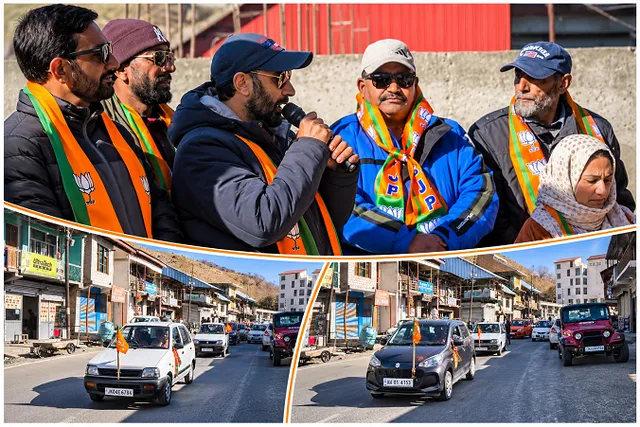
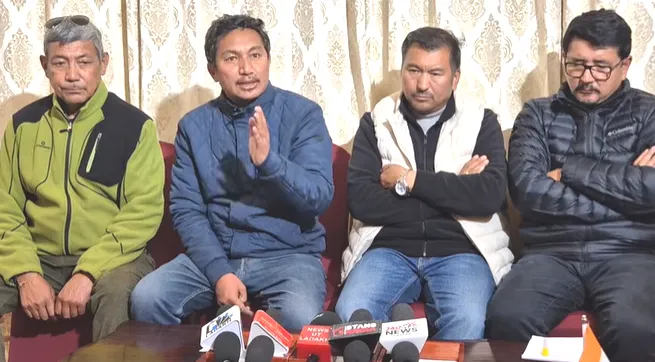
Addressing a press conference in Leh, BJP Ladakh President Tashi Gyalson Khachu, former Lok Sabha MP Jamyang Tsering Namgyal, former Chief Executive Councillor of LAHDC Leh Adv. Tashi Gyalson and former State President Phunchok Stanzin defended the party’s decision to participate in the electoral process, maintaining that democratic institutions must remain functional irrespective of political disagreements or prevailing challenges.
Former MP Jamyang Tsering Namgyal argued that the absence of elected representatives in Panchayats, Municipal Councils and Hill Councils had created considerable difficulties for people in getting their local grievances addressed and pursuing development-related matters.
He maintained that elected institutions were essential for ensuring public participation, accountability and effective delivery of governance at the grassroots level, adding that keeping these institutions without elected representatives ultimately deprived ordinary citizens of an important mechanism for raising their concerns.
Taking on the Congress over its stand on the proposed election boycott, BJP leaders alleged that the party was publicly supporting the boycott while simultaneously preparing to participate in the electoral process.
They questioned what they described as a contradiction between Congress’s public position and its political preparations, arguing that parties seeking to represent people should not discourage participation in democratic institutions.
The BJP leaders also questioned the role of the sitting Ladakh Member of Parliament in taking up issues concerning the region, particularly the Nautor land regularisation issue and liquor policy, stating that these important matters required sustained political attention and effective representation.
The BJP leaders expressed concern that a boycott of the elections could adversely affect women’s political participation, particularly at a time when reservation provisions have opened opportunities for women to enter grassroots democratic institutions.
They argued that withdrawing from the electoral process would undermine the opportunities created for women’s representation and prevent aspiring women leaders from participating in local decision-making.
The party maintained that elections offered an important platform for strengthening women’s participation in governance and ensuring their voices were represented in elected bodies.
On objections to holding LAHDC elections during the harsh winter season, the BJP leadership defended the decision, acknowledging the difficult climatic conditions in Ladakh but maintaining that winter elections were not unprecedented.
The former CEC cited the December 2014 Assembly elections as an example of an electoral exercise conducted during winter, arguing that adverse weather conditions alone should not become a reason for indefinitely postponing democratic processes.
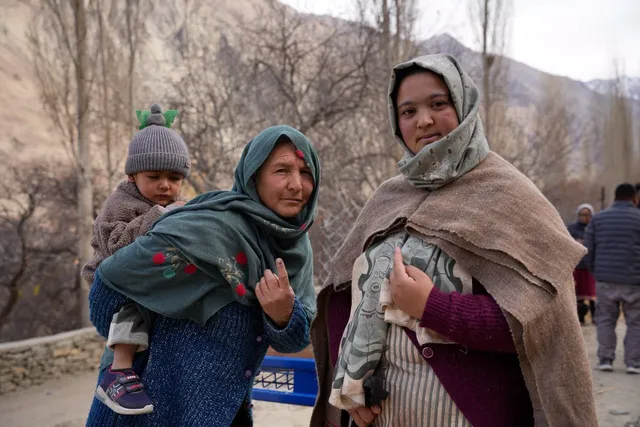
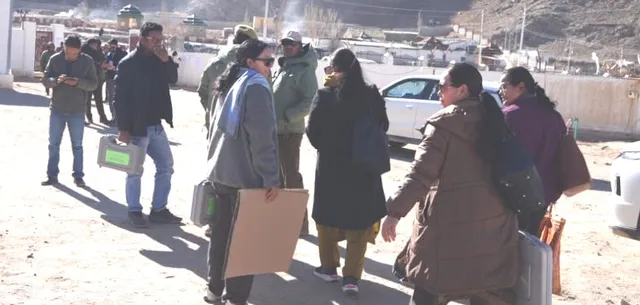
The defence comes amid objections from several political and social organisations over the December 4 polling schedule, with concerns raised about extreme winter conditions, seasonal migration and the difficulties voters in remote areas could face in reaching polling stations.
On concerns surrounding the delimitation of constituencies, the BJP leadership acknowledged dissatisfaction in certain areas but suggested that the exercise could be revisited in the light of the 2027 Census.
The leaders also maintained that the contentious Nautor land regularisation issue could be taken up collectively by the newly constituted Hill Council, indicating that an elected institutional forum would provide an appropriate platform for discussing and pursuing such regional concerns.
The position effectively placed the emphasis on constituting elected bodies first, with contentious policy and administrative issues subsequently taken up through institutional and democratic processes.
Highlighting the administrative and financial implications of delaying the Hill Council elections, the BJP leadership warned that any prolonged delay beyond January or February could adversely affect budget preparation, project planning and development proposals scheduled for March.
The leaders argued that timely constitution of the elected Council was important for ensuring continuity in development planning, processing of proposals and taking decisions concerning local requirements.
They maintained that the absence of an elected Council could complicate the process of identifying priorities, pursuing development projects and ensuring that regional concerns receive due attention in the planning and budgetary process.
The BJP appealed to the people of Ladakh to reject the boycott call and actively participate in the forthcoming Panchayat, Municipal Council and Hill Council elections.
The party urged voters to exercise their democratic rights and elect representatives who could effectively articulate local aspirations, address public grievances and pursue the region’s developmental priorities through constitutional and institutional mechanisms.