Stanzin Lakpa says resignation fulfils commitment to Zanskar; seeks early delimitation and elections to new Hill Councils
KARGIL: In a major political development following the notification extending the Ladakh Autonomous Hill Development Council (LAHDC) framework to all districts of the Union Territory, BJP councillors representing Zanskar have resigned from the Kargil Hill Council, saying the creation of Zanskar as a separate district has fundamentally altered the administrative context in which the councillors were elected.
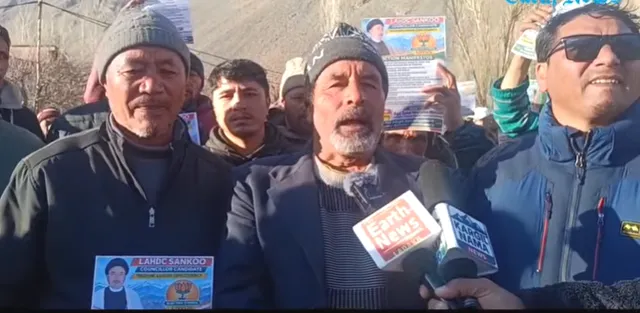
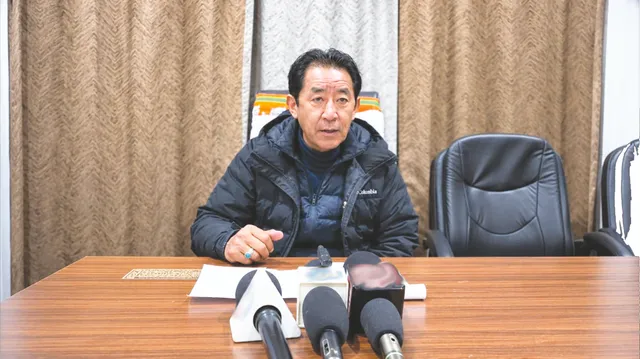
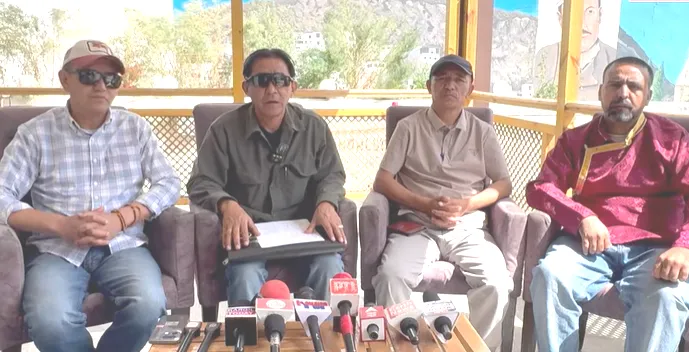
BJP Councillor from Cha constituency in Zanskar, Stanzin Lakpa, announced the resignations at a press conference here, flanked by other BJP councillors who also submitted their resignations to the Chief Executive Councillor (CEC), LAHDC Kargil.
Lakpa said the resignations were not driven by any grievance against the existing Kargil Hill Council or its leadership, but were a consequence of the recent government decision to create new districts and extend the LAHDC system to all districts of Ladakh. “Now that the notification has been issued, we do not find it appropriate to remain in the Kargil LAHDC,” Lakpa said, explaining the rationale behind the decision.
He recalled that he and his colleagues had earlier committed to resign from the Kargil Council immediately after the formal notification for a separate Zanskar district and its Hill Council was issued. “The promise we made to the people of Zanskar is being fulfilled today,” he said.
The BJP councillor, however, made it clear that the resignations should not be interpreted as a political break with Kargil or with ongoing demands of other regions.
He also extended support to the efforts being led by CEC Dr Mohammad Jaffer Akhoon for a separate district for Sankoo and Shargole-Chiktan, saying that his resignation from the Council did not mean withdrawal of support for legitimate demands being pursued by people elsewhere in the district.
“As a person, as a politician and as a BJP worker, our support will always remain with the people of Sankoo and Shargole-Chiktan,” Lakpa said.
A major argument advanced by Lakpa was that the territorial composition of the Kargil Hill Council has undergone a fundamental transformation with the creation of new districts.
He said areas that were earlier part of Kargil district—including Zanskar and Drass, besides other areas affected by the reorganisation—are now being administratively separated. In such circumstances, he argued, the continuation of councillors from these areas in the existing Kargil Council no longer serves the same purpose.
At the same time, Lakpa praised the functioning of the outgoing council and its leadership, particularly CEC Dr Mohammad Jaffer Akhoon. He said the council had accommodated members belonging to different political parties and ideological backgrounds and credited Akhoon with running the institution in an “unbiased” manner. Lakpa also thanked the Deputy Commissioner, heads of departments and other officials for their cooperation during his tenure as councillor.
The BJP councillors have now called upon the government to move quickly towards the next stage of the district reorganisation process.
Lakpa demanded early delimitation of constituencies in all new and existing districts, followed by strengthening of democratic institutions and holding elections to the new Hill Councils at the earliest.
He also sought clarity and sequencing of the Panchayat election process, arguing that if new Panchayat halqas are to be created, their delimitation should take into account the newly created districts and be completed before Panchayat elections are held. “Our demand is that the LAHDC elections should be held first. After delimitation, the new Panchayat halqas can be constituted and elections held,” he said.
The demand effectively places the focus on translating the government’s district-creation notification into an operational democratic structure, rather than leaving the newly created districts without elected representative institutions.
Lakpa used the press conference also to thank his constituents, saying his political contribution to the creation of Zanskar district and development of the region was possible because of the mandate and support he received from voters.
He cited his efforts concerning the MP-D Road, Singe La Tunnel, NH-301 and mobile connectivity in Zanskar, saying whatever contribution he had made towards these initiatives was ultimately due to the confidence placed in him by the electorate.
The councillor said the decision to resign was therefore not merely an administrative step but also the fulfilment of a political commitment made to the people of Zanskar.
In a significant appeal aimed at preventing regional friction following the district reorganisation, Lakpa urged people across Ladakh not to allow the creation of new districts to become a source of social or political division. He stressed that the reorganisation represented an administrative separation and not a separation of people.
He appealed to communities and political parties across Ladakh to preserve the cordial relationships that have existed among them and cautioned against attempts to create divisions or pit one region against another. “The administrative setup is being separated; we are not being separated from one another,” was the thrust of his message.
He said the new districts should instead be viewed as part of an evolutionary administrative process through which Ladakh had already passed—from a single district to Leh and Kargil, and subsequently to the creation of Hill Councils and now further district-level restructuring.
Asked about the position of other BJP councillors in the Kargil LAHDC, Lakpa clarified that the resignations were linked specifically to the territorial and political status of their respective constituencies.
He said councillors whose constituencies have now been placed within the newly created districts had resigned, while the two nominated BJP councillors currently associated with Kargil would continue with the Kargil LAHDC.
He stressed that the remaining councillors would take their own decisions based on their responsibilities and the circumstances emerging in the restructured council. Lakpa also maintained that the BJP councillors had earlier extended unconditional support to the existing council when the General Council and budget proceedings faced delays, despite not being part of the ruling alliance. He said the support was extended in the interest of Kargil’s people so that the budget could be passed without further delay. With the new district structure now formally notified, however, the Zanskar councillors have chosen to step out of the Kargil Hill Council, setting the stage for a fresh political and institutional phase in the region.